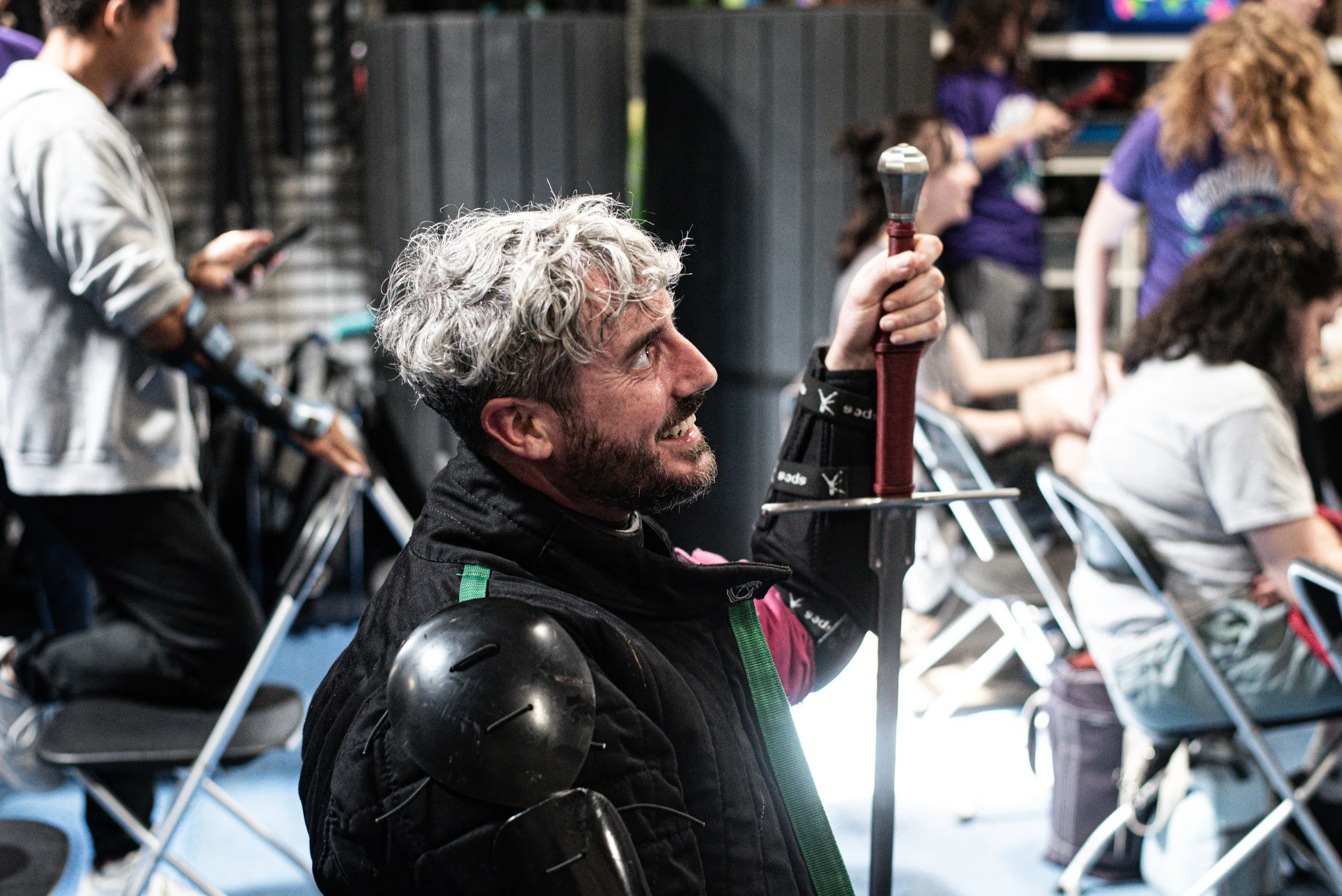
TOURNAMENTS
OPEN LONGSWORD • WNBT LONGSWORD
SEPTEMBER 11, 2026
ENTER THE RING
Tournament registrations must include an event registration at any price tier.
Tournament entries without an accompanying event registration will be canceled and refunded.
OPEN STEEL LONGSWORD
$40
60 participant cap. Open to all genders.
WNBT STEEL LONGSWORD
$40
20 participant cap. Open to all who self-identify as women, nonbinary, or trans.
KNOW THE RULES
RULESET OBJECTIVES
To provide fighters a play area in which to demonstrate their ability to manage distance and timing to execute cuts, thrusts, and approved grappling and takedown techniques against a noncompliant opponent.
To provide judges a rubric by which to compare which fighter is better able to execute (1) without being hit by their opponent.
TOURNAMENT ROLES
DIRECTORS (2)
There will be two directors working in pairs to assist the fighters in competing vigorously and safely. One director will function as time keeper. The time-keeper is expected to keep time accurately, and communicate when a round has ended to the director by shouting “Time!”. The time-keeper is expected to stop the clock when instructed to do so by the director, or when the director says “ring out”. Although only one director will be in the ring with a staff at a time, both directors are able to call halt or ring out or assign penalties.
To this end they should issue the following commands to the fighters under the following circumstances.
“Fight” - Fighters should be instructed to fight at the beginning of the match, and after fighters have moved out of range after every “halt” command.
“Halt” - Fighters should be instructed to halt when any of the following occur during the match.
sufficient hits have landed for the outcome of that exchange to be determined (i.e One fighter has landed multiple hits and the other has not, both fighters have struck each other, etc.) and both fighters are continuing to strike.
There is any issue or suspected issue with a fighter’s protective gear.
either fighter falls/is taken down, or hits the ground.
a fighter loses their weapon simulator outside of a grapple and does not manage to reclaim it immediately
one or both fighters exit the ring
A fighter is seen engaging in behavior that is unsafe to themselves or their opponent. This includes not only illegal techniques as defined in the scoring system, but also things like wildly overswinging into themselves or the floor repeatedly or appearing too rattled or winded to effectively defend themselves. In the event that a fighter is removed from a match for any safety reason, their opponent is considered to have won the match.
Either fighter strikes the other while grappling with a quality hit.
Anything incredibly stupid or ill-advised is about to or has just happened.
Any grapple that begins after a quality hit has been landed, regardless of who initiated the grapple or who landed the hit. If Fighter A strikes Fighter B and then closes the grapple, the director should call halt regardless of whether or not a scoring action has happened in that grapple. If Fighter B initiates the grapple after being struck by Fighter A, the director should still call halt. In both instances Fighter A should get 1 point (assuming the fighter wasn’t struck following their initial attack). The “hit” that lands could be a bad blade grab as well. So if Fighter B grabs Fighter A’s sword out of the air and then initiates a grapple, halt should be called and Fighter A should get a point.
Either or both fighters appear to be escalating the level of force being used within the match in a way that makes either director nervous.
“Ring out” - After entering the ring on the director’s instruction to fight, if a fighter touches the wall or floor outside of the ring with any part of their body, a ring out occurs and the director should call “Halt - ring out”. At this point the timer should stop the clock, and the director will instruct both fighters to return to their starting positions. Once both fighters have returned to their starting positions outside the ring and the director is ready, the director will call “fight” and the time will continue.
“Separate” - When the director calls for fighters to Halt, fighters need to immediately stop attacking and begin moving away from each other till they are out of range. Fighters will be instructed to separate if they have stopped swinging at each other but have not moved completely out of range.
If the director wishes to pause the timer at any point they should call out time.
Directors are encouraged to issue warnings about safety early and often. Director’s are also free to escalate from a warning to a loss of a match if they feel an incident was particularly egregious. Warnings and warning format are outlined in that section.
JUDGES (3)
Judges are expected to make every effort possible to observe and score every exchange that occurs between the two fighters in accordance with the scoring system and definitions as set out in this document. Judges should not enter the ring and should strive to keep both fighters and the space between them within their field of vision at all times.
Judges observe the fighters as they fight. For each exchange fought, the judges assign a score. These scores are cumulative and are added up by the judges for each fighter as the fight progresses. At the end of each pool, scorecards are returned to the scorekeeper who divides each fighter’s score by their opponents’. These values are then averaged for all three judges. The fighter with the highest average value wins. The fighter with the highest average value advances. Each fighter’s score starts at a value of 1 so that a fighter’s score never ends up getting divided by zero.
FIGHTERS (2)
Fighters are expected to be prepared to compete in their pool, and to have a second selected to assist with their gear and to communicate with tournament staff. This includes but is not limited to being at their pools on time and in appropriate gear, and being physically and mentally prepared to fight and defend themselves vigorously for 45 continuous seconds (90 seconds overall). Fighters are expected to defend themselves at all times while in the ring, even after a judge has called ‘halt’. This includes making a reasonable effort not to expose especially vulnerable and difficult to protect areas (Spine, back of head, et al.) to their opponent.
A note on exposing the back of the head - Certain historical techniques (durchlauffen et. al) may result in a fighter exposing the back of their head when performed correctly. If a fighter is going to attempt this technique they should make an effort to either turn so that they are still facing their opponent as they run-through, or cover the back of their head/back with their weapon as they exit their opponent’s range. If a fighter does either of these things they should not be considered to be deliberately exposing the back of their head. Otherwise safety recommendations re:back of the head hits should be followed.
Fighters are expected to obey all commands issued by the director (“halt, separate, fight”) and to respect all decisions made by the judges. Fighters are expected to behave in a sportsmanlike manner at all times as defined by the director. If at any point during the tournament fighters do not think they will be able to discharge these responsibilities effectively they should remove themselves from the tournament by informing the director. If at any point a director judges that a fighter is unable to discharge these responsibilities effectively they are empowered to cause the fighter to forfeit the match at their discretion.
The expectation for fighters is that they are able to communicate to tournament staff with their words and actions that they are ready to compete in a competitive and controlled manner at all times during the tournament. If a fighter is unable to show that they are able to meet that standard, they will be removed from the tournament for both their own safety and the safety of other fencers.
Finally, fighters are expected to understand that our tournament staff is composed entirely of human beings who are volunteering a weekend to give them a competitive experience. Though fallible, they are doing the best they can and should be treated with the appropriate level of respect at all times.
TOURNAMENT FORMAT
Fighters will be sorted into pools based on height. Each pool will have at least 4 fighters, with as many as possible having a full 5 fighters. Pools will be seeded by height first. After height seeding, pools will be arranged to minimize the number of clubmates in the same pool as much as possible, in order to maximize the chance of fighters facing new opponents. Each fighter will fight everyone in the pool once. After all fights are completed, the pool results will be finalized. Eliminations will consist of a set number of fighters from each pool, with any remaining spots in the bracket filled out with wild card fighters based on their overall rank. Rank will be determined by wins, with total points and warnings as tiebreakers.
45s
FIGHT
15s
REST
45s
FIGHT
45s
FIGHT
15s
REST
45s
FIGHT
Each match consists of two 45 second rounds with a 15 second rest in between. When a match starts, director says “Fight”. Fighters fight continuously for two 45 second rounds with a 15 second rest in between moving in and out of measure in a series of exchanges. Judges record the scores for each exchange as they happen. Timekeeper keeps track of the time. Director halts fighters when necessary by calling “Halt”. The fighters should immediately cease attacking each other and back away to be out of measure but still within the ring, while remaining ready to fight. The director may choose to have fighters back away further before continuing. If necessary at this point the director can ask the timer to halt the clock in order to address a gear issue, issue a warning to a fighter for safety or delay of match, or in the event of a ring out. Otherwise the clock does not stop. If two fighters enter a grapple, the grapple goes on until a take down, ring out, or strike in the grapple occurs, or there is a safety violation that happens or looks extremely likely to happen. When the Director calls “Fight”, the fighters continue the match. Otherwise however the clock does not stop. After both 45 second rounds have elapsed the Timekeeper says “time” and fighters stop. The director calls “Halt - Ring out” if a ring out occurs. The timekeeper stops the timer if a ring-out is called, resuming the timer when the director says “fight” after both fighters have reset.
SCORING SYSTEM
An Exchange is defined as a series of blows given and received by fighters while they are in measure. An exchange begins when both fighters are in measure and ends when they leave it or when a halt is declared by the director. A fighter has exited measure when their opponent must take a passing step or a gathering step of equivalent length of a passing step to hit them. Standard reasons for a halt to be called are due to ring-out, multiple strikes having landed without fighters withdrawing out of measure (see below), a strike or strikes followed by a grapple, or a take down having been completed. In addition the director may call a halt for safety or etiquette violations. Putting a hand on the opponent or their weapon (for example starting a blade grab) or trying to push a fighter out of the ring, counts as initiating a grapple and therefore ends an exchange after a strike. Therefore if fighter A lands a hit, and fighter B pushes fighter A out of the ring, the exchange should end when fighter B begins pushing, and only fighter A’s hit should be scored. In keeping with the stated objective above, exchanges are scored based upon who sustained no damage while inflicting a theoretically injurious strike upon their opponent. Judges evaluate this based on the number of strikes exchanged, the quality of said strikes, as well as the occurrence of ring outs and takedowns that end in top position for one fighter, with or without blade presence.
0 POINT EXCHANGE
Occurs when both fighters are struck with quality hits during an exchange. If a fighter is struck after landing multiple quality hits on their opponent, the judges may award them one point at their discretion. However if a fighter is struck after delivering only one hit, no points should be awarded to either fighter.
1 POINT EXCHANGE
Occurs when the scoring fighter hits their opponent with a quality attack and is not struck in return, or when the scoring fighter is able to land multiple quality hits (minimum 2) before being struck. If the scoring fighter deliberately causes the other fighter to be rung out without themselves leaving the ring or being hit they are also awarded one point. Judges award these points, not directors. Directors call the ring-outs for safety reasons and to end the exchange. Multiple one point actions within the same exchange are not added together. For example, if a fighter strikes their opponent once and is not hit and also rings them out without being hit, they receive 1 point, the ring-out stopping the exchange.
2 POINT EXCHANGE
Occurs when a fighter hits with a quality attack that has particular technical merit and is not struck in return. A fighter cannot be awarded two points if they were hit at any point during the exchange. “Particular technical merit” in this case means:
a fighter performs a controlled thrust/winding/or muterien-type action that completely prevents the opponent from striking them during the attack.
A fighter performs a takedown and is able to establish blade presence or top position. If one fighter remains standing after a takedown attempt, that fighter gets two points. If both fighters go down, whoever has a top or dominant position with blade presence when halt is called gets two points.
A fighter is able to disarm their opponent through deliberate action on the scoring fighter’s part (i.e. the opponent does not drop their sword in order to grapple)
The fighter is able to land a pommel strike, thrust, or cut with quality to a legal target while grappling their opponent without being struck in the process.
Essentially, all exchanges are finished after 2 actions by either fencer.
A hit followed by an afterblow and/or a double: 0 points.
1 fighter hits another twice before being hit: 1 point.
A hit followed by an entry into a grapple by either fighter: 1 point for the striking fighter.
An entry into grapple followed by a strike in the grapple, ring out, or takedown:1-2 points depending.
A hit followed by exiting the range of the your opponent: 1-2 points depending.
Continuing to strike at your opponent after this point will result in the fighters being called to break it up and reset and may result in a penalty or ejection from the tournament as detailed in that section.
Quality is defined as being any contact with the opponent that appears to be:
intentional on the part of the attacking fencer
made with the edge or point to any legal target (or pommel to the mask). A
A pommel strike that is delivered while the fighter has adequate posture upon the mesh or top of the opponent's mask is considered to have quality. Moving the fighter’s head with the strike or denting their mask is not required, and could potentially be grounds for penalty for excessive contact. Incidental mask contact with the pommel as a result of another strike or fencing action should not be scored.
Blade Presence is defined as the fighter's ability to potentially strike with the pommel, edge, or point of the weapon upon a downed opponent. This includes half-swording positions.
A takedown is any action taken by a fighter that results in one or both fighters ending up on the ground. Top position is defined as being on top of an opponent after a takedown.
A ring out occurs when either of the fighter’s feet touches the ground outside of the ring, or when a fighter reaches out to touch a wall.
The following are all considered illegal strikes and are grounds for penalties or disqualifications:
Deliberate strikes performed with hands, feet, knees, elbows, shins, or head, with the crossguard, or with the pommel or crossguard while the blade is gripped in both hands.
Throws or takedowns of any kind that remove both of one fighter’s feet from the floor, as well as throws or takedowns that involve “grapevining” or wrapping a leg around an opponent’s leg.
Joint locks.
Cuts to the back of the knee, excessive contact or generally reckless strikes that are considered likely to be injurious.
Striking the opponent in the ankles or feet.
Striking the opponent in the back of the neck or head.
WARNINGS AND PENALTIES
Directors will issue warnings to fighters by calling Halt, calling for time to stop, then saying “Warning (fighter color) for (insert warning). Do you understand that you have been warned (fighter color)?”
During a halt one or both fighters can be warned with any combination of the warnings outlined below. At this point, the fighter’s second may respond that they understand that they have been warned, or ask for the type of warning to be repeated. Although good faith questions about what warning was issued are appropriate, attempts to litigate a warning will result in additional warnings or penalties up to and including the loss of a match and ejection from the tournament. Warnings reset at the end of the match except for the following: illegal target, illegal technique, and control.
These warnings (illegal target, illegal technique, and control) include a -1 point penalty. Warnings that include a point penalty carry over from one match to another and into finals. Acquiring three of the same type of this kind of warning will result in the loss of the match in which the third warning occurred and ejection from the tournament.
Additionally, the total number of warnings a fighter has acquired will be used as a tie breaker when fighters are otherwise tied for advancement into finals, with the fighter with the lower number of warnings advancing.
The following warnings will be issued to fighters during the tournament for ease of communication:
Illegal Target: When someone hits something that they shouldn’t hit with a sword (back of the head, feet, judge, etc.). Each instance of an illegal target warning will result in a one point penalty.
Illegal Technique: Doing something the rules say that you shouldn’t (throws or takedowns that take an opponent off of their feet, striking with the pommel with both hands on the blade, stabbing with the crossguard, etc.) Each instance of an illegal technique warning will result in a one point penalty.
Lack of control of the weapon: Hitting too hard or without control. Unopposed or unforced striking of the floor will be warned in this fashion. You don’t have to connect with excessive force to receive a warning for it. Forcing your opponent’s head or torso to touch a wall is also a control penalty. Each instance of a control warning will result in a one point penalty.
Failing to halt or failing to attempt to halt when halt is called.
Failure to Defend: Turning your head or exposing your own back excessively or irresponsibly during an exchange without making an attempt to defend. Deliberate
Escalation Of Force: Hitting considerably harder than you were at the beginning of the match or deliberately escalating the amount of force being used within a match.
Etiquette: Being rude or disrespectful. Please note that this is not a comprehensive list, as particularly inventive incidents that violate the spirit of the competition may result in the directors having to invent new warnings to account for them. ul to our staff, the fighters, or the space in which we are guests.This includes excessive litigation or rules-lawyering as well as any other violation of our code of conduct.
Receiving three warnings of the same type in one match will result in the automatic loss of that match for the affected fighter(s). The fighter(s) will be considered to have scored zero points. At a director’s discretion, warnings may be given pre-emptively at the beginning of a match if one or both fighters have a history within the pool of engaging in repeated unsafe behavior. Additionally fighters may progress directly to the loss of a match without getting three warnings if an offense is sufficiently grievous (for example, if a fighter uses an illegal technique with sufficient force to render their opponent unable to compete, they will receive no further warnings and will automatically lose the match at a minimum). Warnings will be used as a tiebreaker to advance our most conscientious fighters.
EQUIPMENT
All fighters will present themselves and their equipment to the equipment inspector prior to the beginning of the tournament for compliance inspection and approval. Modifying or removing required equipment after it has passed inspection is grounds for removal from the tournament, unless the fighter notifies a tournament official and is re-inspected.
The Swordsquatch 2026 WNBT and Open Longsword tournaments are “Bring Your Own Steel”; weapons will not be provided by the event. Participants must provide and wear the following:
Weapon: Fighters will provide their own sword from this approved list, all of which have seen extensive use in international competitions (or comparable events) and have reputations for durability, safety, and quality. Fighters wishing to use a sword not on this list must inquire with swordsquatch@gmail.com at least one week before the tournament date. The Tournament staff and administration will not review off-brand/off-model weapons the day of the event unless previous arrangements have been made. All models of sword not featuring an integral safety tip/button/rolled tip at least 1 cm wide must be tipped with a metal washer (or equivalent) and sturdy leather or arrowhead blunt properly secured with strong tape.
Weapons of the noted types from the following makers are pre-approved:
Albion - Meyer
Arm & Armor - Fechtbuch
Fechterspiel Aureus - All feders
Blackfencer - All feders, Sparring longsword
Castille Armory - Standard feder
Comfort Fencing - Dobringer
Darksword Armory - Feder
Ensifer - All feders
Krieger Armory - All feders, Blunt longsword "The Sentinel"
Mac Arms - All feders
Pavel Moc - All feders
Regenyei - All feders except Strong
SGT Blades - All feders
Sigi Forge - All standard and shorter models
Blades that have taken more than a 20 degree set or “S” curve to the blade, even if they can or have been straightened will be deemed stressed to risk of a major fracture & will be rejected as unsafe & unusable. Likewise if during the course of the event a blade which has been deformed & straightened 3 or more times will be considered unsafe & unusable. If a blade shows evidence of being deformed 3 or more times it will also be disallowed as an unsafe blade. Any blade during the course of the event that has been deformed more than 45 degrees will be deemed unsafe & unusable even if straightened.
For steel weapons: It is preferred that sword points not be covered with tape at the pre-competition inspection and that rough edge nicks be filed down.
Mask w/ Back of Head Protection: 3-weapon mask in good condition with no discernible rusting, breaches of the mesh, tongue, or bib. The mask must completely cover the participant’s ears and be neither too large nor small to snugly fit the competitor.
The That Guy/Horsebows perforated steel mask with back of head protection specifically allowed.
The Windrose Fiore sparring helmet is also allowed.
Other headgear (i.e. steel helmets) will be allowed pending inspection for similar criteria as above.
If the mesh of a mask has been deformed more than 1 cm in depth it will be examined by the officials & may be deemed unsafe & thus unusable even if it has been pushed back into shape. If it has been deformed 2cm or greater then it is automatically deemed unsafe & unusable. Further if the mask has been deformed to such a point as to directly contact the head without any significant intervening padding then it will also be disqualified and deemed as unsafe & unusable.
Neck Protection: Some form of rigid neck protection that covers the larynx must be worn. Rigid cervical protection that projects onto the Thoracic vertebrae is highly recommended.
Gauntlets: Fighters must wear gloves or gauntlets which protect the hand, fingers, and the portion of the wrist nearest the hand. Gauntlets must have rigid and padded protection; unpadded gloves are not sufficient. Steel gauntlets are acceptable but the wearer shall NOT use hand-based striking techniques in a match. ·
Steel Tournaments – Absolute Force gloves, Black Lance gloves, Comfort Fencing gloves, Destroyer Modz gloves, St. Mark Koning gloves, Sparring gloves (“Ensifers”), SPES plastic clamshell gauntlets, steel gauntlets, or modified lacrosse/hockey/Red Dragon gloves with significant rigid exoskeleton and fingertip protection are required. Unmodified Red Dragons and lacrosse/hockey gloves are expressly forbidden. Contact us if you have any questions about the acceptability of your gloves. Gloves not on this list must be pre-approved. No exceptions will be granted on the day of the tournament.
Groin and Breast Protection: Use of rigid groin protection (cup/box) is mandatory for fighters with testicles. Pelvic protectors are recommended for everyone. Rigid chest protection is recommended for all participants.
Jacket: Fighters must wear a padded jacket that completely covers the torso, back, and arms. Fencing coaches’ jackets or padded reproduction gambesons are recommended. Gaps in the armpits are not acceptable. An unpadded jacket is acceptable if combined with a padded under-layer such as a hockey shirt. ·
Elbow and Knee Protection: For Steel & Synthetic competitions the use of rigid elbow and knee protection is mandatory. The protection must completely cover the knee and elbow.. ·
Shin and Forearm Protection: Rigid or semi-rigid shin and forearm protection is only encouraged for steel-weapon events, but is recommended for all participants. Gloves with long cuffs may satisfy the forearm requirement provided they are long enough to cover most of the forearm (when worn with the elbow protection). ·
Footwear: Fighters must wear some kind of enclosed toe footwear. Historical reproduction footwear is acceptable, as are minimalist shoes
GET ON THE ROSTER
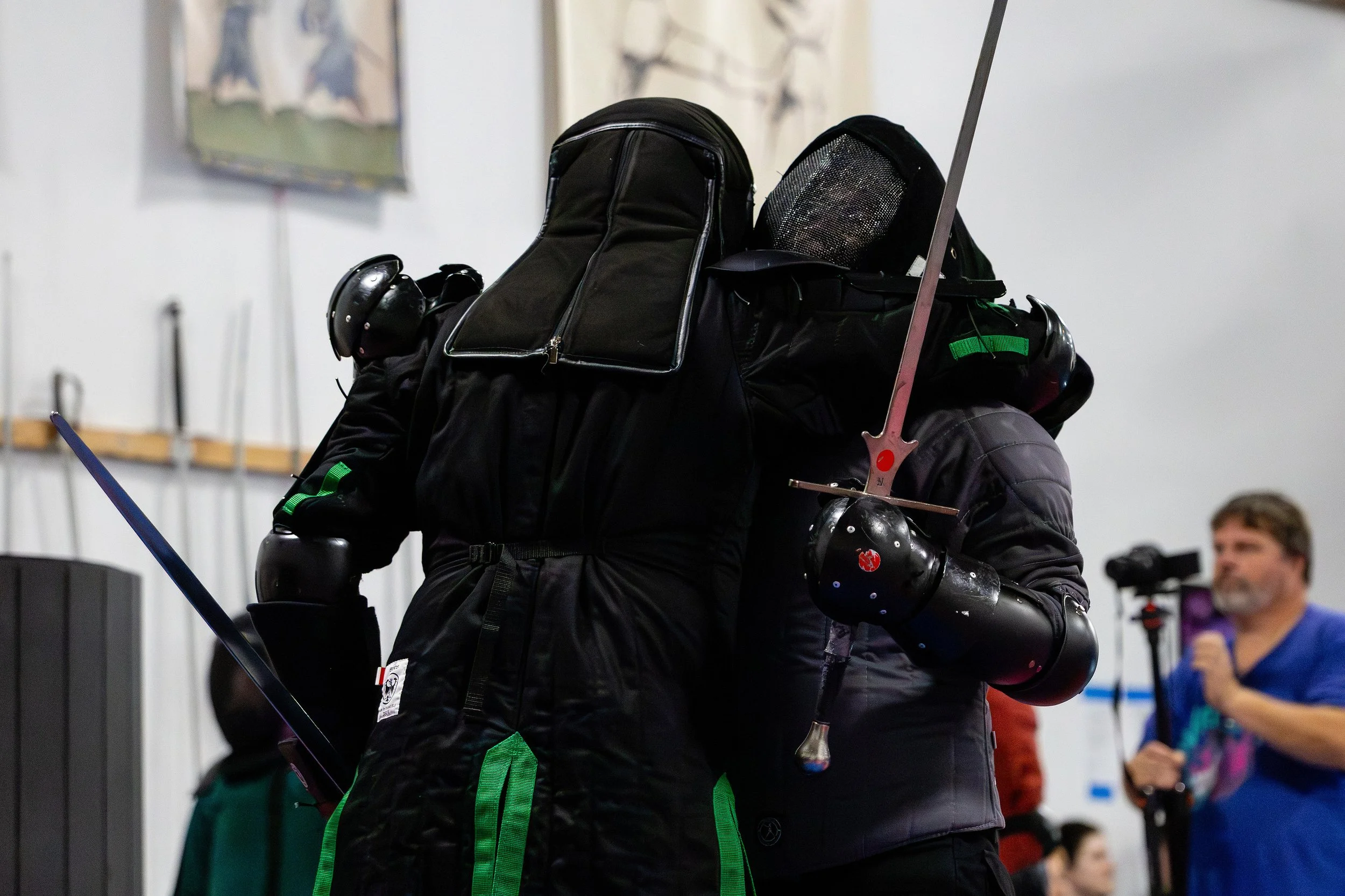
Register now for Swordsquatch 2026 and add tournament registrations to compete.